Friday, December 12, 2014

In Lieu of Promising Practices...

In lieu of going to the Promising Practice  Event, I instead went to three college and community events that took place this semester. It is worth noting that, I was actually registered to attend Promising Practices, however due to some personal complications, attending the event that morning was not possible...

1.Annual ASTAL Author Luncheon - 


ASTAL, or the The Alliance for the Study and Teaching of Adolescent Literature, is a Rhode Island College student organization headed by the esteemed Dr. Jean Brown. This group constantly works to bring the genre of Adolescent Literature into the spotlight and to encourage readers to give YA literature a chance.The 11th Annual ASTAL Luncheon included several acclaimed authors who have local ties to the area. In the event, there were six authors that made an appearance to the luncheon; Kelly Easton Ruben, Liza Ketchum, Mark Peter Hughes, Linda Crotta Brennan, Janet Taylor, and Kristen Tracy. At the luncheon, students were able to hear each author speak, and then was able to dine and chat with them. Students and those registered for the event were also able to get their books signed by the authors, or ask them anything about the book.
Before the actual luncheon, each author gave a reading from their respective novels, and spoke a bit about their life, novels, and careers. After lunch had commenced, one author, Liza Ketchum, who had her hand in the early formation of ASTAL, was honored with the Joan I. Glazer Award, which was made to honor leaders and writers of YA literature. Liza Ketchum also gave a reading of her novel, Out of Left Field, and answered questions about the book, her writing process, and the importance of YA literature.

I thoroughly enjoyed this event, which also provided a number of free books to the participants, as well as raffles to win book bundles filled with YA literature.

2. International Night at Claiborne Pell Elementary School -


At Claiborne Pell Elemantary School, where my six year old son attends first grade, hosted its 2nd Annual International Night. There teachers, students and parents created an event which showcased the different cultures and ethnic identities that composed the school community. The International Night was held on October 14th, after normal school hours.
During the event, the Cafetorium (the space that was used as an Cafeteria and Auditorium), was set up with multiple tables that exemplified a certain culture, country, or people. Each table offered information on its people and cultural practices. Many of the tables also offered samples of delicous food that corrolated with the cultural displayed.
My son Kegan and I had a great time visiting all of the tables and networking with the community members that made up the Pell School community. Kegan and I's favorite table was the Spanish Heritage table, which included pictures of places like Spain, Mexico, and Gautamaula. At this table, there were a few fun hands-on activities. Kegan's favorite activity was making maracas. . He was able to create this out of dried beans, cups, and sticks. Kegan and other students were able to decorate their maracas with colored paper, crayons, stickers, markers and various glitter glues.

I thought this school event at Pell School was extremely important, as it offered students a look into cultures and practices that differ from what they might experience at home. I was extremely surprised at the turn out, and at the number of different cultures that were represented.


3. RI Student Service Summit -


The RI Student Summit (RISSS) is an annual event that was created by the RI Campus Compact, and is held at different campuses around the state each year. The RI Campus Compact describes itself as,
"a vehicle for strategic collaboration of institutions dedicated to the public purpose of higher education within the state. RICC is a coalition of colleges and university presidents dedicated to helping campus-based community service initiatives coordinate, organize, and deepen their individual and collective work, and their collaboration with other service organizations, in order that they might make significant, positive impacts on student learning and the quality of life in the state."
This year the 2014 RI Student Summit was hosted at the Rhode Island School of Design campus, and focused on the theme of “Community Connections and Service." There was a special focus on how to transform your service into a career. and strengthening cross-cultural competence. The RISSS event started at about 9:30am and lasted until about 3pm. During that time, the summit consisted of a keynote speaker, two morning workshops and one afternoon workshop. Before the summit actually started, a networking session was held at breakfast for the attendees. 

Before the first morning workshop, there was a keynote speaker by the name of Michelle DePlante. Michelle is a graduate of Providence College, and received her degree in Global Studies and is an active member in her community. Michelle has served on various community boards including theLatino Dollars for Scholars, the Coalition of Advocates for Student Opportunities (CASA), as well as Juanita Sanchez Community Fund. In Michelle's speech, she reiterated the importance of service learning and community engagement, and talked about her experiences with working with diverse communities and how it has shaped her life. She urged the attendees of the RISSS to become active participants in their community. After her speech, there was a brief question and answer segment.
The summit itself consisted of three workshops, one which happened in the morning, and two that took place after lunch. Students were able to pick which workshops they wanted to attend beforehand, and the three workshops I chose to participate in were as followed: Imagine All the People: Cross-Cultural Collaboration, Developing Definitions of Leadership, and How to Create a Succesful Service Project.

My first workshop to place at 11am, and was Developing Definitions of Leadership. During this workshop, the attendees talked about different leadership styles and the best situations to use each leadership style presented in Danial Goleman's book, "Leadership that Gets Results". Attendees then
tried to evaluate which style they thought they identified with best. The leadership styles presented were,
  • The Coercive Style - If this style were summed up in one phrase, it would be "Do what I tell you." The coercive style is most effective in times of crisis, such as in a company turnaround or a takeover attempt, or during an actual emergency like a natural disaster. This style can also help control a problem teammate when everything else has failed. However, it can alienate people and inhibit motivation and inventiveness.

  • The Authoritative Style - This style leader mobilizes the team toward a common vision and focuses on end goals, leaving the means up to each individual. If this style were summed up in one phrase, it would be "Come with me." This style mobilizes a team, but leaves each individual the freedom to chose how it is completed. The authoritative style works best when the team needs a new vision because circumstances have changed, or when explicit guidance is not required. 

  • The Affiliative Style -  leader works to create emotional bonds that bring a feeling of bonding and belonging to the organization. If this style were summed up in one phrase, it would be "People come first." The affiliative style works best in times of stress, when teammates need to heal from a trauma, or when the team needs to rebuild trust. This style praises teams for their work and strengthens emotional bonds between teammates.

  • The Democratic Style -  leader  If this style were summed up in one phrase, it would be "What do you think?" The democratic style builds consensus through participation and is most effective when the leader needs the team to buy into or have ownership of a decision, plan, or goal, or if he or she is uncertain and needs fresh ideas from qualified teammates.

  • The Pacesetting Style - If this style were summed up in one phrase, it would be "Do as I do." The pacesetting style works best when the team is already motivated and skilled, and the leader needs quick results.

  • The Coaching Style -  If this style were summed up in one phrase, it would be "Try this." The coaching style works best when the leader wants to help teammates build lasting personal strengths that make them more successful overall.
I found that my dominant style of leadership was the Pacesetting Style.

The second workshop I attended was Imagine All the People: Cross-Cultural Collaboration which took place after lunch. In this workshop we talked about how important it is for individuals to keep an open mind when dealing with others who have different value and/or beliefs. We started the work shop with learning the ground rules for speaking in the room. Posted on the wall, the word COLLABORATE  was written on a large sheet of paper. After each letter, a phrase or word was written which was to be considered the rule. 

CONFIDENTIALITY
OPEN MIND
LEARN FROM OTHERS
LISTEN TO OTHERS
AUTHENTICITY
BRAVE SPACE
OFFER SPACE TO OTHERS
RESPECT
AGENCY; OWN YOUR PERSPECTIVE
TIMING
ENGAGE COVERSATION

After the ground rules had been gone over, the group all shared personal stories about times that we have felt uncomfortable do to issue of cultural misunderstandings or miscommunication. Some of the stories shared were difficult to listen to and very heart-breaking. It really showed the amount of cultural insensitivity that resides in the world.

The last workshop I had was called How to Create a Successful Service Project. This workshop was really informal, and we spent most of the time bouncing ideas off each other on what exactly we considered a "successful" service project. Some of the ideas we came up with were as followed:
A Successful Service Project is...

  • a learning experience for all who are involved.
  • where a dialogue is started
  • where there is increased awareness on the service topic
  • where goal that are set are reached
  • where a personal connection is formed to the service topic or people involved
  • where relationships with a culture or community is formed
  • where a change in perception occurs
  • where networking happens (Schools, community, organizations)

I really enjoyed this event. Its funny because I never knew about this organization, or the things they do with the colleges around the state. I had only found out about this through a mass email sent from RIC's Liz Gafarlo.


Citizenship in School: Conceptualizing Down Syndrome...

"Citizenship in School: Conceptualizing Down Syndrome," Schooling Children with Down Syndrome, Christopher Kliewer (1998)


At the basis, "Citizenship in School: Conceptualizing Down Syndrome" was a call for those without any form of disabilities to become aware of the unique issues those with Down Syndrome experience in their lives. Like most minority groups, the individuals who have Down Syndrome struggle constantly to live lives that are equal to their peers who do not have any form of physical or mental disability. This is often because those with Down Syndrome, like other minority groups, are placed firmly out of Delpit's "culture of power" and the ideals that represent SCWAMMP. How do we know this? Well remember that the "A" in SCWAMMP refers to "Able-Bodied." However, this is not to say that those with Down Syndrome are actually not able-bodied, but how those with this disability are viewed.

This text also comments about the issues those with Down Syndrome face in our public schools. Much of the time, those with Down Syndrome, or those who possess a form of physical, or especially mental impairments, are placed into separate learning spaces, effectively cutting them off from others that make up the student population of the school. As quoted in the text, this sorting in schools "justify a competitive ethic that marginalizes certain students or groups of students ... [and] legitimize[s] discrimination and devaluation on the basis of the dominant society's
preferences in matters of ability, gender, ethnicity, and race ..." (73).

Jeannie Oakes
As I stated in class during our discussion of this text, reading this piece made me reflect to almost all the other authors we read beforehand. But, more than any others, this article made me reflect back to Jeannie Oakes and her text on tracking within schools. Oakes maintained that tracking in schools provided the students with "uneven opportunities". Studies have shown that students who were identified as "less able" or "low achieving" in schools received a quality of education that were less than those who did not have this label.

This thought is reiterated in "Citizenship in School." For example, take into consideration the story of John Mcgough. John attended a segregated school with others who had Down Syndrome. John's school experience was "stagnant" and lonely because due to tracking, as he was cut off from his community. Because John has Down Syndrome, he was removed from the "normal" population and instead of identified as a person with unique views, thoughts and opinions, he was treated as just another kid with Down Syndrome. John became "a walking pathological syndrome, a mobile defect on the loose." Luckily for John, he was able to move to a new area and was able to integrate himself into the community. But what about those who don't have that option? 

Like Oakes writes in her text, "feeling comfortable in class is more than just a nice addition to learning" (179). When students feel like they are seen as valued and accepted participants in their community, they flourish. Much like John did.

"Citizenship in School" reminds us that those with disabilities, like those with Down Syndrome, or any minority group for that matter, want to be seen as individuals before they are seen as stereotypes from their respective minority group.

Juliette Lewis stars in a movie called, "The Other Sister." It is a poignant film about the difficulties a young woman with a mental disability faces in her life. Although, Juliette Lewis does not portray a woman with Down Syndrome, it is still and interesting look into the lives of those who live with mental disabilities.

Tuesday, November 18, 2014

Literacy With Attitude

"Literacy With An Attitude" Patrick J. Finn (1999)


First, I would like to say, holy cow!, that was a lot of condensed reading.


Anyways, although the excerpt from Patrick Finn's book "Literacy with an Attitude" was terribly long, there were some really interesting ideas. 

Somewhere through the reading, I kept hearing the saying, "Knowledge is power!" I've probably heard it a trillion times during ABC's Saturday morning cartoon block as a child, and hundreds more times on inspirational school posters. This simple motto was used to inspire a love of learning in children; to teach them, that with education, anything was possible, any dream fulfilled. But after reading this text, it leaves me wondering, how much power does one actually get with knowledge? 


But Finn's text begs the reader to consider the quality of knowledge which students are receiving, and rallying others to become active members in changing the quality of education for the better. Knowledge, or literacy, if anyone can access the same knowledge, why are there such vast differences in the quality and implementation of literacy when it comes to education? 
Now that education can now be accessed by everyone, what other insidious ways is the caste forming to  perpetuate disadvantage? Students in the same town, school district, and even same school building are getting a different quality of education. 

Take Jean Anyon's research about the striking differences seen in education between New Jersey's social classes. Anyon found that students from high earning families received a far superior quality of education than students who were from working class or even middle class families. Well, you're first thought is probably "D'uh!," I mean private school vs. public school. You'd assume that private schools have the better education, but ask yourself the question of; why is the education better? Better school curriculum? Better student to teacher ratios? Better teachers? What is it about the teachers that make them better? 
Well, Anyon  would say its a series of these things. Her studies found that not only did the very foundations of how students were taught differed drastically based on class, but also that students were often educated only enough to support their role in their respective social class (think West Virginia coal-mining communities).

This really made me reflect on my own schooling. I would say that my school was located in an area where most of the families were of middle-class background. I was taught in a school setting where there were "special" classes for students. There were students in my school that needed extra hand, and often were taken out of class for the mystery that was 'special instruction', and there were others who excelled and rewarded with college prep courses or special electives. I, on the other hand, had neither. My school life, and my life outside it were separated. My classes weren't spectacular and my schooling was pretty average, although now as an adult, I see that my education mirrored in the text in some ways. Anyon found that in other schools like mine,
"The dominant theme in the middle-class school was possibility. There was widespread anxiety about tests and grades but there was a pervasive belief that hard work would payoff. These students viewed knowledge as a valuable possession that can be traded for good grades, a good college education, and a good job (14)."
This doesn't sound so bad until you realize that students with families in  the working-class received education that "...was often evaluated in terms of whether the steps were followed rather than whether it was right or wrong (10), lacking both creativity and teacher enthusiasm. 

Students coming from wealthy families received education that was less restrictive, open to creativity, and thrived on personal excellence.

The worst part is, "we all participate in this social system as if it were natural, the way things were meant to be" (Preface  X). Finn urges his readers and those emerging teachers to become "transforming intellectuals" to incite change in the way education and literacy is dispensed.
I really enjoyed reading about Paulo Freire


All students should be afforded quality education that affords them to become active "participants in the culture circles [that] think about culture, how they create it and engage in it and how, since it is something they create, it is something they can change."

Finn, and Freire, believe this is only possible through open dialogue within the classroom, must like those students from wealthy families receive. 
But, don't begrudge the wealthy kids, because apparently, "teachers in gentry schools often engage in dialogue with their students, not because the teachers "empower" the students, but because the students are already powerful (168)."

As we see again, the further those are from a place of power, the harder it is to change anything.


Thursday, November 6, 2014

Browns v. The World

I first want to say that Tim Wise, author of “Between a Rock and a Hard Place” was correct when he stated in his interview,

 “… contrary to a lot of rhetoric we’re hearing; we’re no where near a post-racial America.”


Wait, wait...What?


So how do we know that we still need to work on becoming a post-racial society? Well, we could turn on the TV... Or we can realize texts like McIntosh’s “White Privilege Knapsack” still rubs people the wrong way. We know that racism in America is still a problem because we still have issues with segregated schools (closer than you think!), and newspapers are still running stories like Salim Muwakkil wrote about. Or, just ask Jo(s)e Zamora.

Slavery in the United States lasted for over 245 years; slavery has only been abolished half as long as slavery’s entire duration. And, in all things considered, it has been a relatively short time since the U.S. Supreme Court struck down racial segregation in public schools. Brown v. Board of Education only happened sixty years ago. That is not even a lifetime for most people. And I'm sure there are still many people from that time that can remember Brown v. Board of Education kicking... or, erm... shuffling about. 

But I also think that it’s okay for everyone to be “cautiously optimistic” about the topic of race relations. In comparison to most countries, we're still young. We are still working through a healing process, so to speak. We have to continually make sure we have our "global glasses" on; making sure we are looking through to our society with empathy to culture and life experiences.


 I feel Wise summed it up marvelously in his interview,

  “It would be dishonest and I think disrespectful to suggest the ball hasn't moved quite a ways… But my concern is that every other time that we've seen, and look we’re in black history month as I’m speaking to you, the reality is that, in this month, we learn about the accomplishments of individual folks of color, and most of them accomplished the things that they accomplished under a system of formal apartheid. Under a system of formal white supremacy. So even in the midst of horrible oppression individuals of color can accomplish great things”

So how do we translate this? Take Bob Herbert, for example, columnist from the New York Times. Bob writes, 
"Schools are no longer legally segregated, but because of residential patterns, housing discrimination, economic disparities and long-held custom, they most emphatically are in reality."

So, we still live in a society that is not yet post-racial. We can see this because of segregation in schools to this day, except now its under the insidious ploy of classism. We can see this when 6 out of 10 white adults readily accept stereotypes about black people as common knowledge. 

Who really knows the long term impacts of prejudice and discrimination (they might)? 

But here's the catch. It is going to be an on-going push to achieve the goal of a post-racial society. We are going to play the whole game of Monopoly, and not just quit when someone gets mad. It's going to take everyone, not just the disadvantaged. Do not collect $200. Go directly to Delpit. Page 26. ;)


But! We have a black president... so that's something... right?

Right.


Because every step counts. 


We're one black president closer to a post-racial society! Guys, it's kind of a big deal. 


'Merica!


Tuesday, October 28, 2014

A Little Something Extra From Sweden....

As I was clicking through the infinity that is the interweb, I stumbled across this interesting article. I wanted to post it, because I feel it is really relevant to some of the things we were talking about in class.

The article, talks about how equality for all is gaining a stronghold for the LGBTQ  community in Sweden. 

Read the article! I think you'll see we can connect this to August's Safe Spaces, however, I think we can see how Sweden I working to dismember the ideals of SCWAMMP, in a small way. 


Happy reading!

Sunday, October 26, 2014

"Unlearning the Myths that Bind Us," Linda Christensen -- Revisited


In Christensen's text, Unlearning the Myths That Bind Us, she wrote about the many ways that media influences us in the way we think about ourselves and others. In this text, Christensen provides her students with texts, movies, and cartoons for them to find underlying discriminations. Many of her students were able to find many misogynistic, racist, and classist stereotypes in much of the media that was viewed, whilst incorporating gender roles for both boys and girls. Furthermore, the media that was viewed by Christensen's students, was media meant to be viewed by children. So in a nutshell, some of the most disturbing messages and "life lessons" came from some of the "innocent" media. For example, take this statement which was quoted in Christensen's text, 
"The impact of racism begins early. Even in our preschool years, we are exposed to misinformation about people different from ourselves. Many of us grow up in neighborhoods where we have limited opportunities to interact with people different from our own families... Consequently, most of the early information we receive about "others" - people racially, religiously, or socioeconomically different from ourselves - does not come as a result of firsthand experience. The secondhand information we receive has often been distorted, shaped by cultural stereotypes, and left incomplete..." (127). 

This discovery becomes even more appalling when Christensen specifically cites cartoons and fairy tales as the main outlets where we gather our preconceived notions about the world at large. This "innocent" media was in actuality a "secret education" for children, or anyone who watched. Christensen urges her students to become aware of this "secret education" because it becomes a lens in which we view the world with.

Christensen implores her students and readers to see that "innocent" media can become dictators on how to live one's life. It is as Dorfman writes, 
"[...] We are not only taught certain styles of violence, the latest fashions, and sex roles by TV, movies, magazines, and comic strips; we are also taught how to succeed, how to love, how to buy, how to conquer, how to forget the past and suppress the future. We are taught, more than anything else, how not to rebel" (128).
Thank you Erika!
 So what does this mean exactly? It means that while the media teaches us the various roles in life that that we are to follow, it is also working to homogenize society, separating and discarding the most important aspects which makes each of us special and individual. Most of us do not even see the insidious message even though it shows up in more places than just children's media. Jessica had a great example in her blog, as she talked about a class she took last semester. 
"In this course, we discussed everything Christensen did in this piece. Every week we were dissecting a show, movie, book, or advertisement and were able to see just how racist and sexist most of the things we grew up with actually are. Many times, I found myself to be pretty upset with our findings."
Her experience is backed up by Christensen who states, "students have also said that what they now see in cartoons, they also see in advertising, on prime-time TV, on the news, in school" (134). So these detrimental life lessons and messages are everywhere! You just have to look closely.


Take Mary Carter Smith's retelling of the classic Cinderella story, "Cindy Ellie, A Modern Fairy Tale". Although Smith does work to reimagine Cinderella to become more relatable
Different princess, but same idea! Thank You Lindsey L.!
to current times, and a reflection for ethnic girls, the 
"secret education" about gender roles stays the same: Women need to be beautiful to catch a guy, prince or not.
"Both of the Cinderellas [modern black Cindy Ellie and traditional Cinderella] compete for their men against their sisters and the rest of the single women in their cities. They "win" because of their beauty and their fashionable attire. Both of these tales leave young women with two myths: Happiness means getting a man, and transformation from wretched conditions can be achieved through consumption - in their case, through new clothes and a new hairstyle" (133). 
This also really reminds me of this 1997 Cinderella movie! Great use of interracial characters, but the story's gender roles are the same. 
Essence also brings up a great point about how young boys and men can be affected by media as well. She writes, 

"This reminds me of the SWAAMP activity. The (M) which stood for Maleness, had certain stereotypes such as; a hard worker, strong, and a good provider. We see these stereotypes portrayed in the male leads of Disney movies. The prince in Snow White was seen as the hero. He was the only one that could save the damsel in distress with a kiss. Prince Eric was seen as the hero who saved Ariel from Ursula. It not only influences young girls it also influences young boys. The media makes them think they have to be strong, fearless and throw themselves into situations whenever a woman is in trouble. It doesn't matter if she ask for your help. It is your “duty” to help her. Once you help her she will fall in love with you."


In Ashley's blog, she talks about how one of her school peers was not allowed to watch Disney movies, and how Ashley at the time thought it was odd. It is interesting to think that perhaps that Ashley's peer's mother had some information of the "secret education" of media, and chose to keep her daughter from it.


I leave you with a thought wonderfully said by Justine, one of Christensen's students,"True death equals a generation living by the rules and attitudes they never questions and producing more children who do the same" (129).


Tuesday, October 21, 2014

Service Learning - Charity vs Change

"In The Service Of What? The Politics of Service Learning" Kahne and Westheimer, 1996


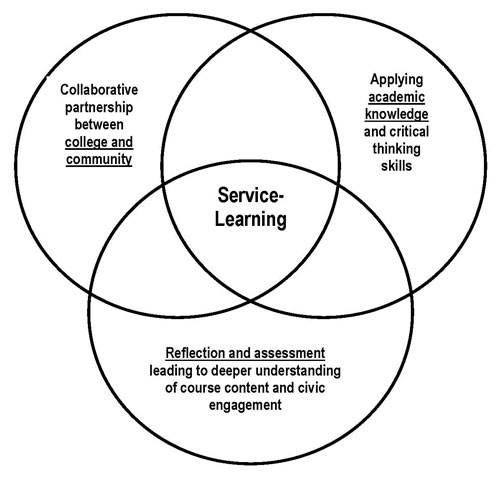
In Kahne's and Westheimer's text, they explain the importance of students completing service learning in their academic careers. Both authors agree that service learning is important, although they do separate it into two sub-categories; charity and change

To be completely honest, reading this text was appallingly boring for me, and it really didn't leave a lasting impression. It also took class discussion to really pinpoint what the author(s) argument was. I felt that the text was filled with examples that mirrored each other fairly closely, and when reading, I did not think the difference between "charity" fueled service learning, and "change" fueled service learning was readily apparent. However, as I had mentioned, through class discussion (and worksheet!) I was able to make more sense of what the text was trying to put forth. So, with that in mind, I want to reflect on my own service learning.

So, what's the difference between charity service learning and change service learning? Let's explore two stories in the text to find out:

Consider "Serving Those in Need," Mr. Johnson's project for his 12th-grade U.S. government course [...] Mr. Johnson had his students participate in community service projects of their own choosing. For example, one student worked in a center for babies whose mothers had high levels of crack cocaine in their bloodstreams during pregnancy. Another worked in a hospital, running errands for doctors and helping patients locate the sites for their appointments. A third student prepared and distributed survival kits for the homeless...(3).

The story above is suppose to be an example of charity service learning. But what is it about it that makes it charity as opposed to change
Ms. Adams, a seventh-grade teacher at Lexington Middle School, took a different approach. Working together, Ms. Adams and her students identified issues of common concern and then voted to focus their energy on the issue of homelessness. Their service learning unit-"Homelessness Here and Elsewhere"-examined the social. economic. legal, and political determinants of homelessness around the world and in the local school community. The class invited speakers from homeless advocacy groups, created files of newspaper articles on homelessness, and read, among other items, 'No Place to Be: Voices of Homeless Children,' They developed action plans to aid relief efforts for the homeless in their own communities and raised funds for two homeless advocacy groups that the class had selected. During whole-class and small-group discussions and also in writing. they reflected on the readings, on what they had learned from the invited speakers, and on their own experiences while working on the project (3).

In both Mr. Johnson's and Ms. Adams's class, students are donating their time to civil issues, though they do differ in one distinct way. Mr. Johnson only required students to offer their time in their service learning, whereas Ms. Adam's students not only offered their time to their chosen service learning, they also researched it, and made plans in which they could possibly fix the issue. To use Dr. Bogad's statement (and Kozol's idea of temporary vs permanent fixes), Mr. Johnson's class would be using a "band-aid fix" to repair the broken leg (civil issue) instead of a "surgical fix" like Ms. Adam's class.

Mr. Johnson's required service learning only asked students to donate their time, or as the text states, "the approach to service learning taken by Mr. Johnson stresses charity and the ways in which participating in service and reflection can develop students' sense of altruism" (4). Meaning the service learning in this class was to help the students. Conversely, Ms, Adams's students were required to do more than simply donate their time to their issue. Those students were required to research, read, and most importantly brainstorm "action plans" to benefit and help their community. So, Mr. Johnson's students' service learning is charity driven, while Ms. Adams's students service learning is change driven.

 When I read about some of the service learning that Mr. Johnson's class completed, I realized that it was, in a way, sort of what my own service learning was. When I go to help out in the classroom, my service learning is restricted to the classroom. I only have the ability to offer my time to the students that I work with, regardless of what I am helping them with. For example, during my service learning, I split my time between to classrooms, an English class and a Math class. In each class, I have the opportunity to work with students with their coursework. 

However, with that in mind, I realized today in class, that this is the only thing that I'm doing. My service learning is missing a key component; advocacy. Yes, I'm helping students figure out proper grammatical rules or mathematical equations, but that's where my job ends. I am not creating any other lasting effect. This revelation is kind of depressing in a way; to realize that I'm using a "band-aid fix" as the basis of my service learning. Furthermore, when I think about any volunteer, or service learning I have completed to date has been like this. I find that in most schools, it is true that "much of the current discussion regarding service learning emphasizes charity, not change."
However, I do still think that I make a difference, albeit even if it is a small one. If I can connect with one student, and inspire them to want to learn, I think I'm on the right track.


Looking for more information? Checkout the EPA's View on Service Learning.