Tuesday, October 28, 2014

A Little Something Extra From Sweden....

As I was clicking through the infinity that is the interweb, I stumbled across this interesting article. I wanted to post it, because I feel it is really relevant to some of the things we were talking about in class.

The article, talks about how equality for all is gaining a stronghold for the LGBTQ  community in Sweden. 

Read the article! I think you'll see we can connect this to August's Safe Spaces, however, I think we can see how Sweden I working to dismember the ideals of SCWAMMP, in a small way. 


Happy reading!

Sunday, October 26, 2014

"Unlearning the Myths that Bind Us," Linda Christensen -- Revisited


In Christensen's text, Unlearning the Myths That Bind Us, she wrote about the many ways that media influences us in the way we think about ourselves and others. In this text, Christensen provides her students with texts, movies, and cartoons for them to find underlying discriminations. Many of her students were able to find many misogynistic, racist, and classist stereotypes in much of the media that was viewed, whilst incorporating gender roles for both boys and girls. Furthermore, the media that was viewed by Christensen's students, was media meant to be viewed by children. So in a nutshell, some of the most disturbing messages and "life lessons" came from some of the "innocent" media. For example, take this statement which was quoted in Christensen's text, 
"The impact of racism begins early. Even in our preschool years, we are exposed to misinformation about people different from ourselves. Many of us grow up in neighborhoods where we have limited opportunities to interact with people different from our own families... Consequently, most of the early information we receive about "others" - people racially, religiously, or socioeconomically different from ourselves - does not come as a result of firsthand experience. The secondhand information we receive has often been distorted, shaped by cultural stereotypes, and left incomplete..." (127). 

This discovery becomes even more appalling when Christensen specifically cites cartoons and fairy tales as the main outlets where we gather our preconceived notions about the world at large. This "innocent" media was in actuality a "secret education" for children, or anyone who watched. Christensen urges her students to become aware of this "secret education" because it becomes a lens in which we view the world with.

Christensen implores her students and readers to see that "innocent" media can become dictators on how to live one's life. It is as Dorfman writes, 
"[...] We are not only taught certain styles of violence, the latest fashions, and sex roles by TV, movies, magazines, and comic strips; we are also taught how to succeed, how to love, how to buy, how to conquer, how to forget the past and suppress the future. We are taught, more than anything else, how not to rebel" (128).
Thank you Erika!
 So what does this mean exactly? It means that while the media teaches us the various roles in life that that we are to follow, it is also working to homogenize society, separating and discarding the most important aspects which makes each of us special and individual. Most of us do not even see the insidious message even though it shows up in more places than just children's media. Jessica had a great example in her blog, as she talked about a class she took last semester. 
"In this course, we discussed everything Christensen did in this piece. Every week we were dissecting a show, movie, book, or advertisement and were able to see just how racist and sexist most of the things we grew up with actually are. Many times, I found myself to be pretty upset with our findings."
Her experience is backed up by Christensen who states, "students have also said that what they now see in cartoons, they also see in advertising, on prime-time TV, on the news, in school" (134). So these detrimental life lessons and messages are everywhere! You just have to look closely.


Take Mary Carter Smith's retelling of the classic Cinderella story, "Cindy Ellie, A Modern Fairy Tale". Although Smith does work to reimagine Cinderella to become more relatable
Different princess, but same idea! Thank You Lindsey L.!
to current times, and a reflection for ethnic girls, the 
"secret education" about gender roles stays the same: Women need to be beautiful to catch a guy, prince or not.
"Both of the Cinderellas [modern black Cindy Ellie and traditional Cinderella] compete for their men against their sisters and the rest of the single women in their cities. They "win" because of their beauty and their fashionable attire. Both of these tales leave young women with two myths: Happiness means getting a man, and transformation from wretched conditions can be achieved through consumption - in their case, through new clothes and a new hairstyle" (133). 
This also really reminds me of this 1997 Cinderella movie! Great use of interracial characters, but the story's gender roles are the same. 
Essence also brings up a great point about how young boys and men can be affected by media as well. She writes, 

"This reminds me of the SWAAMP activity. The (M) which stood for Maleness, had certain stereotypes such as; a hard worker, strong, and a good provider. We see these stereotypes portrayed in the male leads of Disney movies. The prince in Snow White was seen as the hero. He was the only one that could save the damsel in distress with a kiss. Prince Eric was seen as the hero who saved Ariel from Ursula. It not only influences young girls it also influences young boys. The media makes them think they have to be strong, fearless and throw themselves into situations whenever a woman is in trouble. It doesn't matter if she ask for your help. It is your “duty” to help her. Once you help her she will fall in love with you."


In Ashley's blog, she talks about how one of her school peers was not allowed to watch Disney movies, and how Ashley at the time thought it was odd. It is interesting to think that perhaps that Ashley's peer's mother had some information of the "secret education" of media, and chose to keep her daughter from it.


I leave you with a thought wonderfully said by Justine, one of Christensen's students,"True death equals a generation living by the rules and attitudes they never questions and producing more children who do the same" (129).


Tuesday, October 21, 2014

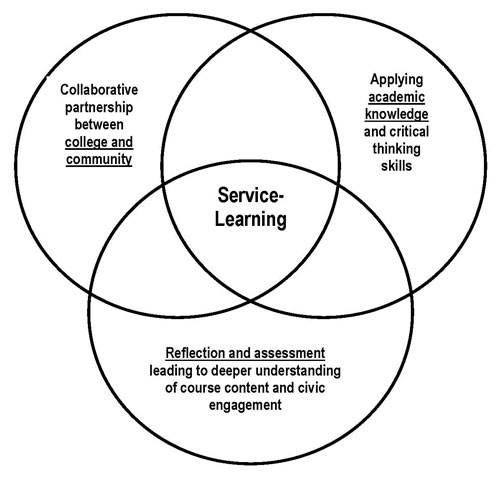
Service Learning - Charity vs Change

"In The Service Of What? The Politics of Service Learning" Kahne and Westheimer, 1996


In Kahne's and Westheimer's text, they explain the importance of students completing service learning in their academic careers. Both authors agree that service learning is important, although they do separate it into two sub-categories; charity and change

To be completely honest, reading this text was appallingly boring for me, and it really didn't leave a lasting impression. It also took class discussion to really pinpoint what the author(s) argument was. I felt that the text was filled with examples that mirrored each other fairly closely, and when reading, I did not think the difference between "charity" fueled service learning, and "change" fueled service learning was readily apparent. However, as I had mentioned, through class discussion (and worksheet!) I was able to make more sense of what the text was trying to put forth. So, with that in mind, I want to reflect on my own service learning.

So, what's the difference between charity service learning and change service learning? Let's explore two stories in the text to find out:

Consider "Serving Those in Need," Mr. Johnson's project for his 12th-grade U.S. government course [...] Mr. Johnson had his students participate in community service projects of their own choosing. For example, one student worked in a center for babies whose mothers had high levels of crack cocaine in their bloodstreams during pregnancy. Another worked in a hospital, running errands for doctors and helping patients locate the sites for their appointments. A third student prepared and distributed survival kits for the homeless...(3).

The story above is suppose to be an example of charity service learning. But what is it about it that makes it charity as opposed to change
Ms. Adams, a seventh-grade teacher at Lexington Middle School, took a different approach. Working together, Ms. Adams and her students identified issues of common concern and then voted to focus their energy on the issue of homelessness. Their service learning unit-"Homelessness Here and Elsewhere"-examined the social. economic. legal, and political determinants of homelessness around the world and in the local school community. The class invited speakers from homeless advocacy groups, created files of newspaper articles on homelessness, and read, among other items, 'No Place to Be: Voices of Homeless Children,' They developed action plans to aid relief efforts for the homeless in their own communities and raised funds for two homeless advocacy groups that the class had selected. During whole-class and small-group discussions and also in writing. they reflected on the readings, on what they had learned from the invited speakers, and on their own experiences while working on the project (3).

In both Mr. Johnson's and Ms. Adams's class, students are donating their time to civil issues, though they do differ in one distinct way. Mr. Johnson only required students to offer their time in their service learning, whereas Ms. Adam's students not only offered their time to their chosen service learning, they also researched it, and made plans in which they could possibly fix the issue. To use Dr. Bogad's statement (and Kozol's idea of temporary vs permanent fixes), Mr. Johnson's class would be using a "band-aid fix" to repair the broken leg (civil issue) instead of a "surgical fix" like Ms. Adam's class.

Mr. Johnson's required service learning only asked students to donate their time, or as the text states, "the approach to service learning taken by Mr. Johnson stresses charity and the ways in which participating in service and reflection can develop students' sense of altruism" (4). Meaning the service learning in this class was to help the students. Conversely, Ms, Adams's students were required to do more than simply donate their time to their issue. Those students were required to research, read, and most importantly brainstorm "action plans" to benefit and help their community. So, Mr. Johnson's students' service learning is charity driven, while Ms. Adams's students service learning is change driven.

 When I read about some of the service learning that Mr. Johnson's class completed, I realized that it was, in a way, sort of what my own service learning was. When I go to help out in the classroom, my service learning is restricted to the classroom. I only have the ability to offer my time to the students that I work with, regardless of what I am helping them with. For example, during my service learning, I split my time between to classrooms, an English class and a Math class. In each class, I have the opportunity to work with students with their coursework. 

However, with that in mind, I realized today in class, that this is the only thing that I'm doing. My service learning is missing a key component; advocacy. Yes, I'm helping students figure out proper grammatical rules or mathematical equations, but that's where my job ends. I am not creating any other lasting effect. This revelation is kind of depressing in a way; to realize that I'm using a "band-aid fix" as the basis of my service learning. Furthermore, when I think about any volunteer, or service learning I have completed to date has been like this. I find that in most schools, it is true that "much of the current discussion regarding service learning emphasizes charity, not change."
However, I do still think that I make a difference, albeit even if it is a small one. If I can connect with one student, and inspire them to want to learn, I think I'm on the right track.


Looking for more information? Checkout the EPA's View on Service Learning.

Tuesday, October 14, 2014

Unlearning the Myths That Bind Us...

"Unlearning the Myths That Bind Us," Christensen (2003)


    For this week, I thought it would be interesting to see what the general take was with fairytales and Walt Disney movies. It's true that these fairy tales become the social primer which most kids base their lives on without even knowing it. Many people would say that fairy tales are important to child development, helping them understand violence and hope. I cannot say that I view that statement to be incorrect. However, these stories also confer things to children other than how to process good and evil. These stories often show what evil looks like, and what good looks like, which successfully creates boxes into which then everything, and everyone, in their life gets sectioned into. 


Many of the stories told by Walt Disney, are old tales, hijacked and "normalized" for the time (this site talks about some of the stories that Disney used to make his iconic movies). By doing this, Disney has inserted lessons that every child now unconsciously picks up. These lessons often come hidden, but rife with inequalities with gender, race, class, and even personal attractiveness.


I thought this video I found on good ol' Youtube sums up a lot of the controversial issues that were talked about in the text we read this week. 

As a child, like most girls, I dreamed of being a princess. I wove sheets around me in layers which became my satin and silk dresses, and wore towels and scarfs around my hair to serve as long flowing locks.I did this to become beautiful. Because the media that I was watching (most of the time Disney movies) told me that beauty and a good life came to those who were rich and beautiful, with long flowing locks. These movies told me what I was, just wasn't good enough.


So, what is Disney really teaching children? Many people would argue that Disney is teaching RACISM and SEXISM... And I think I would agree.

Wednesday, October 8, 2014

LGBTQ

"Safe Spaces: Making Schools and Communities Welcoming to LGBT Youth," G. August, M. Kennedy, A. Vaccaro


"History is written by the victors" - Winston Churchill (but not really?).

What does this quote make you think of? Triumph? An underdog, or an "above all odds" story?

Is the intrinsic truth of the quote a "one size-fit all"? Think about it, we'll go back to it....


I have been thinking about an interesting point that Dr. Annie Russell had made during her presentation yesterday. She commented that when students are educated on the civil rights movements of our country, they rarely are, if ever, taught about important civil right movements that have to do with the LGBTQ community.

I know I didn't learn about any important information in my academic life that regarded to the LBGTQ community. Honestly, the closest I got to learning anything vaguely about the LGBTQ civil movements as an adolescent was in Psychology, when I had to remember the date when when the American Psychiatric Association removed homosexuality from the list of mental disorders in 1973 (and you can see the APA's stance has quite changed since then). In many of my classes, I've come to realized I was taught about civil movements, but only the ones that were deemed "appropriate" or  movements that would directly represent the "world view" that those in power accepted as teachable.

Now as I look back on my education, I see many important civil movements that I was not taught about, which I think would have enriched my understanding of people today. I think that when speaking about civil right movements, or highlights, those of the LGBTQ nature could have been included into the discussion very easily. It is not a matter of choosing one over the other; you can introduce important historical LGBTQ movements via correlation. For example, in school, I learned about many civil right movements listed below on the right, the things on the left represent correlating civil right movements in the LGBTQ community.


What I learned…


What I could also have learned…
1963 March on Washington; Martin Luther King delivers his famous "I Have a Dream" speech.
   1979 — the National March on Washington for Lesbian and Gay Rights in Washington, D.C.


1964 — Civil Rights Act of 1964 is      signed by President Johnson.
President Johnson signs Civil Rights Act of 1964 

   1977 — Activists in Miami, Florida pass a civil rights ordinance making sexual orientation discrimination illegal in Dade County. Save Our Children, a campaign by a Christian fundamentalist group and headed by singer Anita Bryant, is launched in response to the ordinance. In the largest special election of any in Dade County history, 70% vote to overturn the ordinance. It is a crushing defeat for gay activists.

 1968 — Martin Luther King is shot, and assassinated by James Earl Ray.
1978 — Harvey Milk, a gay man and a member of the San Francisco Board of Supervisors, is assassinated by Dan White.
Harvey Milk


1971 — The Supreme Court, in Swann v. Charlotte-Mecklenburg Board of Education, upholds busing as a legitimate means for achieving integration of public schools. Although largely unwelcome (and sometimes violently opposed) in local school districts, court-ordered busing plans in cities such as Charlotte, Boston, and Denver continue until the late 1990s.


1996In Romer v. Evans, the Supreme Court strikes down Colorado's Amendment 2, which denied gays and lesbians protections against discrimination, calling them “special rights.” According to Justice Anthony Kennedy, “We find nothing special in the protections Amendment 2 withholds. These protections . . . constitute ordinary civil life in a free society.”


** Historical facts from here and here. :)

Sunday, October 5, 2014

Multilingual Students and the ESL Experience

"Teaching Multilingual Children," Virginia Collier (2004)


Many will tell you, that one of the worst afflictions hounding children over generations has been, and will always be, school. For one reason or another, children, especially those in secondary schools, has found the act of learning to be extremely exhausting. So much so, that kids find any reason they possibly can not to go... A truth known to students even before Mr. Bueller took his day off in 1986.

So, kids find school to be difficult... what of it?


Let's pretend you're all taking a trip.


 A trip to another country entirely, and somewhat backwards in time as well. Let's pretend you're back in grade school, learning Physics, Algebra, Chemistry, Shakespeare, and proper essay structure, and all the other crazy intense stuff for your age.


And now, let's pretend that you now are taking all these classes and learning all this complex stuff in Sweden. That's right, Sweden. And did I mention you don't know a lick of Swedish, and the only thing your ever heard about Sweden is something to do with delicious red gummy candies?
Now really think about how difficult it would be for you to adjust, let alone to learn.
How you would like to be taught Swedish, as a native English speaker? How would you like your teachers to treat you? 

Suppose you are put into a classroom where the teacher only speaks Swedish. You're incredibly confused for most of the lesson, but you've got a few Swedish phrases down, but then you realize that you have to use the bathroom. And for the life of you, you can't remember how to ask to use the facilities.
So you go up to your teacher, and you say, "Ursäkta, lärare... um...Bathroom?" And your teacher looks at you and babbles Swedish. Of course you give a blank stare, because you have no idea what they're saying, so you try again,"Var... är... bathroom? Where is the bathroom?" And once again your teachers babbles in Swedish again, but this time pointing to the clock, and then to your seat. So, you go back to your seat feeling frustrated in your ability communicate, and wondering why the hell the teacher was pointing at the damn clock. After class, the teacher pulls you aside and tells you, for the umpteenth time, "Talar svenska endast i klassen. Nej , talar engelska." Which you have come to find out means, no English in class.
*English to Swedish translator used!


Welcome to the life of an English as a Second Language learner. 

Of course this is only an example, out of many other difficulties, I have thought of to give us some perception of how difficult life for a ESL student must be. In Virginia Collier's text, "Teaching Multilingual Children", it is situations like this Collier urges us as educators to avoid. 


If you look back at our transcontinental time-travelling example story, you'll see that the Swedish teacher taught in a way that directly conflicts with what Collier said was important when teaching an ESL learner (or SSL -- Swedish as a Second Language in our case :] ); specifically her listed guidelines #3 and #5.  
3. "Don't teach a second language in any way that challenges or seeks to eliminate the first language." 
  • In relation to Collier's text, the Swedish teacher chose to teach in a way that did seek to remove or eliminate your native language English from the classroom, and this can be seen in the teacher's refusal to use any other language but Swedish to teach the class.

5. "Do not forbid young students from code-switching in the classroom. Understand the functions that code-switching serves."
Virginia Collier
  • Now let's think about how you attempted to communicate your needs to the Swedish teacher. You could not remember the word for "toilet" or "bathroom" in Swedish, so as you attempted to communicate in Swedish you used words from your native language, English. Collier states that doing this is called "code-switching," and this linguistic feature is very important. In Collier's text, she says "Accepting code-switching 'might produce better academic  results than a constant preoccupation with maintaining a single language'" (230). Collier stresses that doing this, when learning a new language is neither bad or lazy. 


*****************************************


Now, let's think about the Swedish educator in the example. The teacher made no effort to communicate in a way that would be easy for a struggling multilingual student. The teacher relied heavily on complex verbal communication; although  provided with some gesturing, the message remained unclear to the original question, and left you, the student, feeling inadequate in the way you were able to communicate.
Collier would disagree with the way the teacher conducted the conversation because she states that, "...teacher should be aware of the special kind of speech that mothers and fathers use automatically with their children, and try to emulate this" (224). Collier calls this "caregiver speech"; and two important parts of this speech consists of:


  • "Caregivers speak in short and simple sentences"
  • "Caregivers provide models to children by saying for them what the children seem to want to say"


The teacher in this example obviously did not work to incorporate these guidelines in the conversation. Instances like these may hinder a student's courage to further engage in conversations with their educator, and may result in further engagement in the classroom.

As you pictured yourself as the student, did the situation make you mad? This is only one instance. What if you had to go through similar situations of miscommunication everyday, would you start to feel defeated and out of place?


So, again; what's my point? If life as a adolescent student is difficult and tumultuous at best when speaking only one language, when integrating a student into a curriculum or cultural setting that differs from their own native background, the everyday stresses of schooling may seem tenfold to a struggling multilingual student. I believe that Collier is absolutely correct in her assessment of how multilingual children should be taught. Although it is the educator's job to "facilitate academic language development" (225), it cannot be lost that it is extremely important "to allow the child to express [themselves]... which encourages learning" (230).