"In The Service Of What? The Politics of Service Learning" Kahne and Westheimer, 1996
 In Kahne's and Westheimer's text, they explain the importance of students completing service learning in their academic careers. Both authors agree that service learning is important, although they do separate it into two sub-categories; charity and change.
To be completely honest, reading this text was appallingly boring for me, and it really didn't leave a lasting impression. It also took class discussion to really pinpoint what the author(s) argument was. I felt that the text was filled with examples that mirrored each other fairly closely, and when reading, I did not think the difference between "charity" fueled service learning, and "change" fueled service learning was readily apparent. However, as I had mentioned, through class discussion (and worksheet!) I was able to make more sense of what the text was trying to put forth. So, with that in mind, I want to reflect on my own service learning.
So, what's the difference between charity service learning and change service learning? Let's explore two stories in the text to find out:
Consider "Serving Those in Need," Mr. Johnson's project for his 12th-grade U.S. government course [...] Mr. Johnson had his students participate in community service projects of their own choosing. For example, one student worked in a center for babies whose mothers had high levels of crack cocaine in their bloodstreams during pregnancy. Another worked in a hospital, running errands for doctors and helping patients locate the sites for their appointments. A third student prepared and distributed survival kits for the homeless...(3).
The story above is suppose to be an example of charity service learning. But what is it about it that makes it charity as opposed to change?
Ms. Adams, a seventh-grade teacher at Lexington Middle School, took a different approach. Working together, Ms. Adams and her students identified issues of common concern and then voted to focus their energy on the issue of homelessness. Their service learning unit-"Homelessness Here and Elsewhere"-examined the social. economic. legal, and political determinants of homelessness around the world and in the local school community. The class invited speakers from homeless advocacy groups, created files of newspaper articles on homelessness, and read, among other items, 'No Place to Be: Voices of Homeless Children,' They developed action plans to aid relief efforts for the homeless in their own communities and raised funds for two homeless advocacy groups that the class had selected. During whole-class and small-group discussions and also in writing. they reflected on the readings, on what they had learned from the invited speakers, and on their own experiences while working on the project (3).
In both Mr. Johnson's and Ms. Adams's class, students are donating their time to civil issues, though they do differ in one distinct way. Mr. Johnson only required students to offer their time in their service learning, whereas Ms. Adam's students not only offered their time to their chosen service learning, they also researched it, and made plans in which they could possibly fix the issue. To use Dr. Bogad's statement (and Kozol's idea of temporary vs permanent fixes), Mr. Johnson's class would be using a "band-aid fix" to repair the broken leg (civil issue) instead of a "surgical fix" like Ms. Adam's class.
Mr. Johnson's required service learning only asked students to donate their time, or as the text states, "the approach to service learning taken by Mr. Johnson stresses charity and the ways in which participating in service and reflection can develop students' sense of altruism" (4). Meaning the service learning in this class was to help the students. Conversely, Ms, Adams's students were required to do more than simply donate their time to their issue. Those students were required to research, read, and most importantly brainstorm "action plans" to benefit and help their community. So, Mr. Johnson's students' service learning is charity driven, while Ms. Adams's students service learning is change driven.
When I read about some of the service learning that Mr. Johnson's class completed, I realized that it was, in a way, sort of what my own service learning was. When I go to help out in the classroom, my service learning is restricted to the classroom. I only have the ability to offer my time to the students that I work with, regardless of what I am helping them with. For example, during my service learning, I split my time between to classrooms, an English class and a Math class. In each class, I have the opportunity to work with students with their coursework.
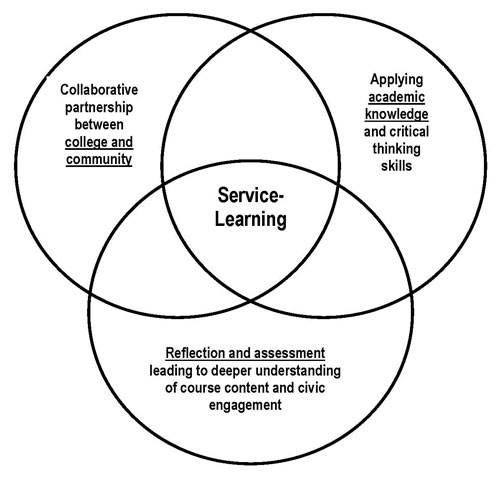 However, with that in mind, I realized today in class, that this is the only thing that I'm doing. My service learning is missing a key component; advocacy. Yes, I'm helping students figure out proper grammatical rules or mathematical equations, but that's where my job ends. I am not creating any other lasting effect. This revelation is kind of depressing in a way; to realize that I'm using a "band-aid fix" as the basis of my service learning. Furthermore, when I think about any volunteer, or service learning I have completed to date has been like this. I find that in most schools, it is true that "much of the current discussion regarding service learning emphasizes charity, not change."
However, I do still think that I make a difference, albeit even if it is a small one. If I can connect with one student, and inspire them to want to learn, I think I'm on the right track.

No comments:
Post a Comment